A South Haven waterfront listing this fall might come with a rental license that isn't fully settled. That's not a defect in any specific property. It's the residue of a citywide ordinance overhaul that ran through most of 2026, and it changes how a buyer should read a listing that advertises income potential.
Here's the mechanism. South Haven replaced its old short-term rental rules, known as Article X, with a new system under Article V, Chapter 14. Every STR registered under the old ordinance expires on or before May 1, 2026, which meant close to 700 properties needed to clear a fresh zoning compliance review and biannual inspection cycle on a tight timeline. By March 2026, city staff had processed roughly one in five of those applications. City Manager Kate Hosier told the council the department was falling behind the number of STRs it needed to clear before the deadline, and Zoning Administrator Kelly Getman-Dissette confirmed the same 20 percent figure at a Committee of the Whole meeting that month. The council's fix was a conditional license, approved effective March 27, 2026, that let owners keep renting while the city worked through the backlog, provided they had a complete application and fee on file.
That's the friction. What makes it worth understanding now, in September, is where in the market it actually lands.
The Two Markets Hiding in One Number
South Haven's citywide numbers read like a market catching its breath. As of September 2026, the median sale price of a home in South Haven sat at $587,000, down 2.7 percent from a year earlier, while the median list price tracked closer to $550,000, essentially flat. A market that's flat on the surface can still be reshaping itself underneath, and the regional shoreline data for the broader Lake Michigan corridor from Stateline to South Haven shows exactly that kind of reshaping.
Across the trailing twelve months ending July 31, 2026, total shoreline sales rose a modest 1.92 percent, 265 homes against 260 the year before. Split by property type, true waterfront sales climbed 4.69 percent to 67 closings, and water-access sales, homes near but not directly on the water, rose 2.86 percent to 180. Neither number moves much on its own. The movement is buried one level down, inside the price bands.
At the very top, the $3 million-plus waterfront tier posted 16 sales in the trailing twelve months, double the 8 sales in the prior period, a 100 percent increase. Absorption in that tier runs around 5.25 months, unusually fast for a price point that can otherwise sit unsold for a year or more. One tier down, the traditional $1 million to $2 million waterfront band pulled back sharply over the same period. And the segment posting the tightest seller's market on the entire shoreline isn't the luxury tier at all. It's the $500,000 to $999,000 range, the band where most vacation-home and investment buyers are actually competing.
| Price Band | Trailing 12-Month Movement | What's Happening |
|---|---|---|
| $3M+ waterfront | Sales doubled (8 to 16) | Fast absorption, unusually liquid for the price point |
| $1M-$2M waterfront | Pulled back sharply | Cooled demand relative to the tiers above and below it |
| $500K-$999K | Tightest seller's market on the shoreline | Where most vacation-home and STR buyers compete |
| Under $500K, water access | Sales down 15.79% (32 vs. prior year) | Thin, shrinking inventory at the entry tier |
The under-$500,000 water-access segment tells its own story. Sales there fell 15.79 percent, to just 32 closings, though the segment is small enough that a handful of transactions can swing the percentage more than they swing the underlying market. Inventory is thin, and thin inventory produces fewer closings even when buyer demand hasn't actually changed.
What It Looks Like on the Golden Mile
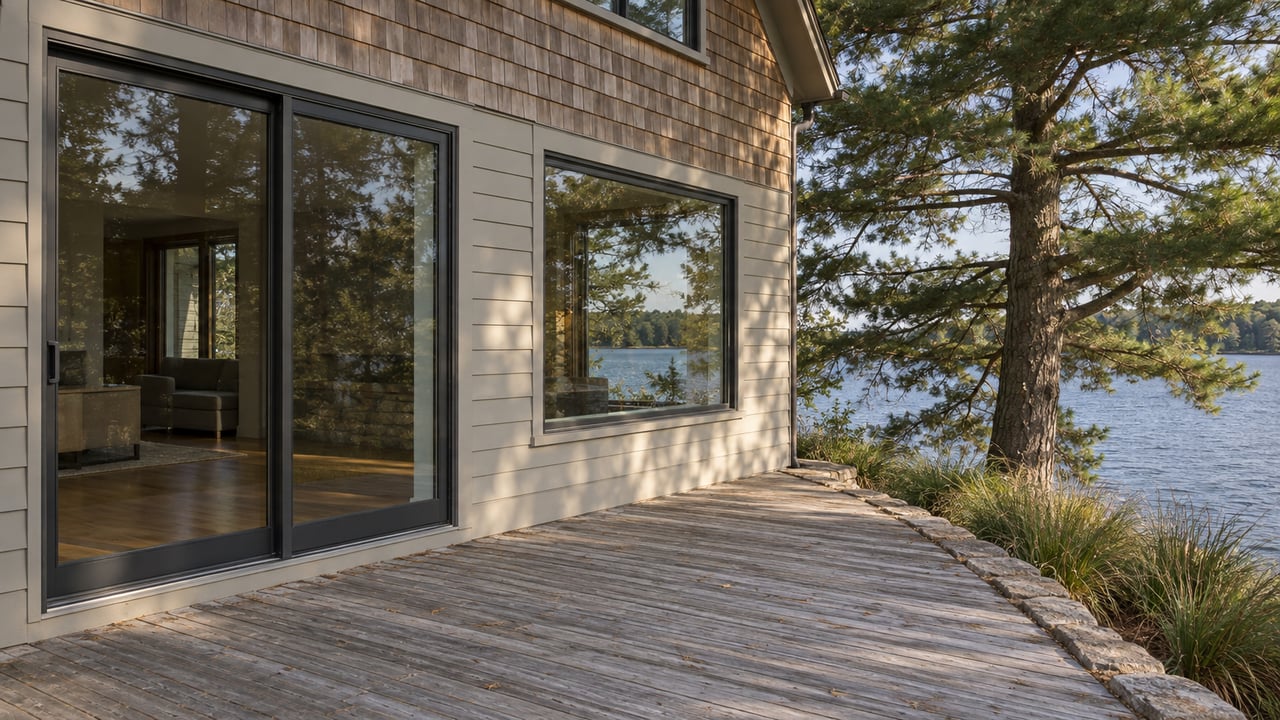
South Haven's Golden Mile, the stretch of shoreline north of downtown, is where this bifurcation shows up in individual listings rather than aggregate percentages. One parcel on the market this fall was being offered for the first time in three generations: over 100 feet of private beach, a low bluff with minimal steps to the water, sitting just outside city limits where township taxes run lower than the city rate. That's the kind of holding that doesn't turn over on a normal market cycle, and its scarcity is part of what's pushing the top tier's absorption rate down to five months instead of twelve or more.
A few doors down the same corridor, a main-floor condo was marketed differently: a proven short-term rental history, immediate income potential, positioned as a low-maintenance second home. That's the $500,000 to $999,000 buyer profile in miniature, someone weighing lifestyle use against rental performance rather than holding a family parcel for the view.
Further south, past the city line near Glen Haven Shores, listings carry a different kind of disclosure. One offers 120 feet of Lake Michigan frontage with a note that the shoreline has held up well, though many owners on that stretch have invested in long-term revetment work to keep it that way. Another lists a bluff-front property explicitly priced to reflect the cost of a needed revetment system. None of that shows up in a median price. It shows up in the difference between what a listing asks and what a buyer actually has to spend to keep the lot stable.
Two Numbers That Don't Agree With Each Other
Here's where the citywide data gets genuinely useful. Redfin's September 2026 read on South Haven shows the median sale price per square foot at $407, up 39.9 percent year over year. Movoto's read for the same month shows the median list price per square foot at $294, down 6 percent from the month before and 5 percent from a year earlier.
Those two numbers aren't contradicting each other by accident. One measures what's asking, the other measures what's closing, and a nearly 40 percent jump in closed price per square foot alongside a softening asking price points to a market where the homes that actually sell are skewing toward the higher end, even as the broader pool of listings cools. That's consistent with the shoreline report's finding: the $3 million-plus tier is unusually active right now, and closings at that level pull the average up even while the middle of the market takes longer to move.
For a buyer using the median as a shorthand for "what South Haven costs," that's a meaningful distortion. The number isn't wrong. It's just describing a different set of transactions than the one most vacation-home buyers are actually competing in.
The License Question That Belongs in Due Diligence
This is where the price data and the licensing rollout connect. The $500,000 to $999,000 band, the tightest seller's market on the shoreline, is also the band where most STR-motivated buyers are shopping. That's precisely the population most exposed to the licensing transition that ran through 2026.
South Haven's new ordinance splits STR licenses into two structures. Owners can hold a license allowing unlimited rental activity but capped at no more than two rental stays per seven-day period, which requires proof of $1 million in liability insurance. Alternatively, owners can hold a license allowing six rental terms or 28 rental days per calendar year, which requires submitting exact rental dates to the city's STR Program Coordinator before guests arrive. These aren't interchangeable, and a property's rental income potential depends heavily on which one it holds.
Under the new ordinance, STRs are also treated as legally non-conforming uses. That has a specific consequence: owners generally can't expand or intensify the rental use beyond what was already established, which means an unpermitted addition, like an extra bedroom added years ago without a permit, may not count toward the property's licensed capacity once it goes through zoning compliance review. City staff have said maintenance work is generally fine, but remodeling triggers individualized review.
A few things worth confirming before writing an offer on a South Haven property marketed with STR income:
- Which license type the current owner holds, and whether it transfers with the sale or requires a fresh application
- Whether the property has completed zoning compliance review under Article V, or is still operating on a conditional license
- Whether any past renovations, additions, or bedroom conversions were permitted, since unpermitted work may not carry forward as licensed rental capacity
- The current status of the city's review queue, since the system that replaced Article X only ran through its first full season this year
None of this means South Haven is a difficult place to buy an investment property. It means the ordinance transition and the price bifurcation are two sides of the same story: the market segment where buyers are most active is also the one where the paperwork is least settled, and confirming a license's actual status matters more than the asking price on its own.
The Golden Mile parcel that's been in one family for three generations doesn't carry this risk in the same way, because it was never operating as a licensed rental. The condo two doors down, marketed on its rental history, absolutely does.
If you're comparing South Haven to other lakeshore towns and trying to figure out which price band actually matches your plans for the property, that's a conversation worth having before you tour anything. David Isljamovski works this stretch of the West Michigan lakeshore daily and can walk through what a specific address's license status actually looks like before you make an offer.